Matcha vs Coffee: Which One Should You Drink?
Compare caffeine, energy, taste, jitters, and benefits to choose the best morning drink.
Some mornings feel like a coffee morning.
You know the kind. The alarm rings. Your brain opens one eye, looks at the day’s to-do list, and quietly asks to speak with management.
Other mornings, coffee feels like too much. Too bold. Too fast. Too “let’s answer 47 emails before breakfast.”
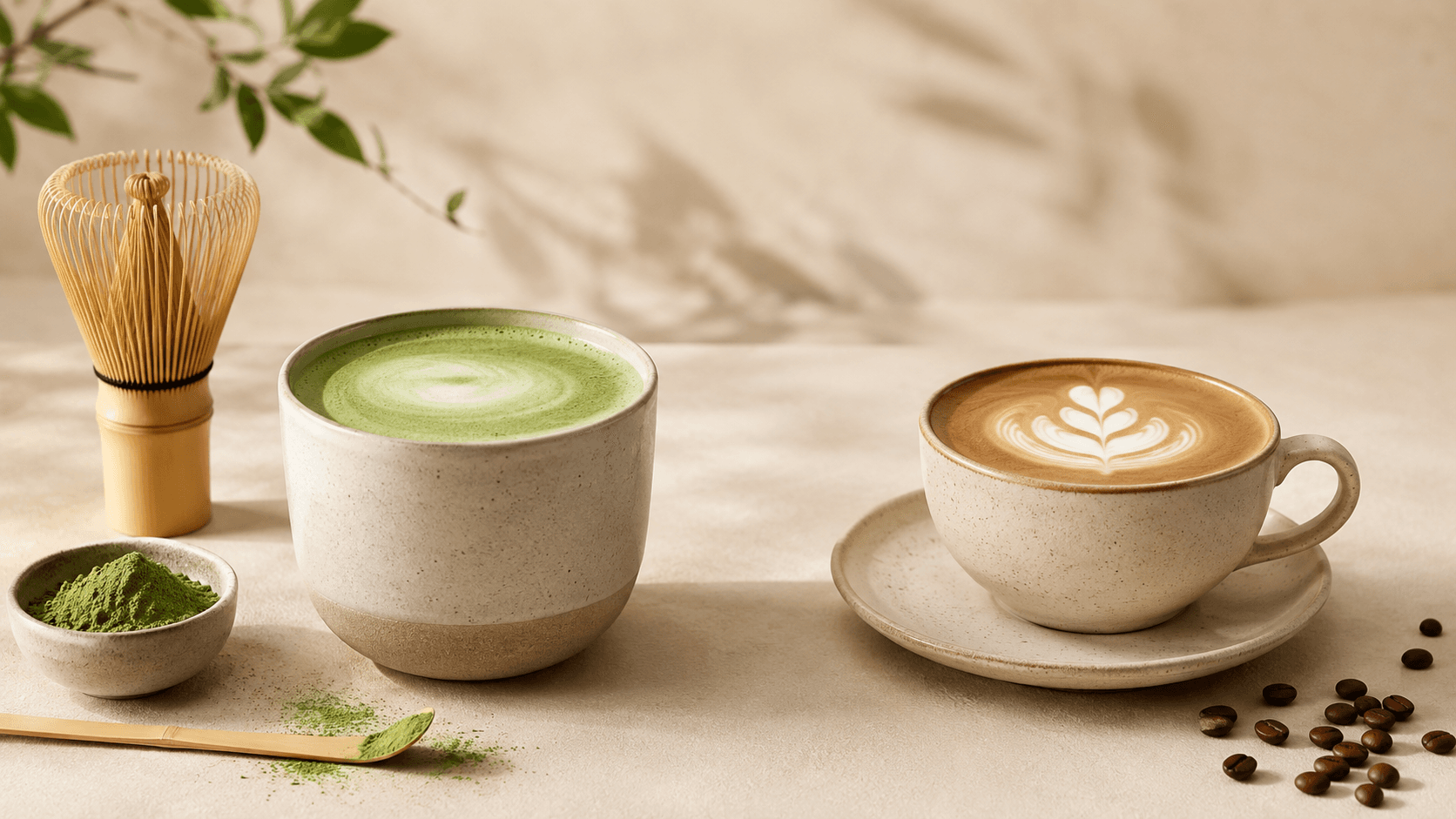
That’s when matcha starts looking tempting: soft green powder, creamy latte dreams, calm-energy promises, and that little wellness glow that makes you feel like you might finally become the kind of person who owns matching storage containers.
So here we are: Matcha vs Coffee.
Which one should you drink?
The honest answer is: it depends on what your body needs today. Coffee and matcha both contain caffeine. Both can become a lovely morning ritual. Both can help you feel more awake.
But they do it differently.
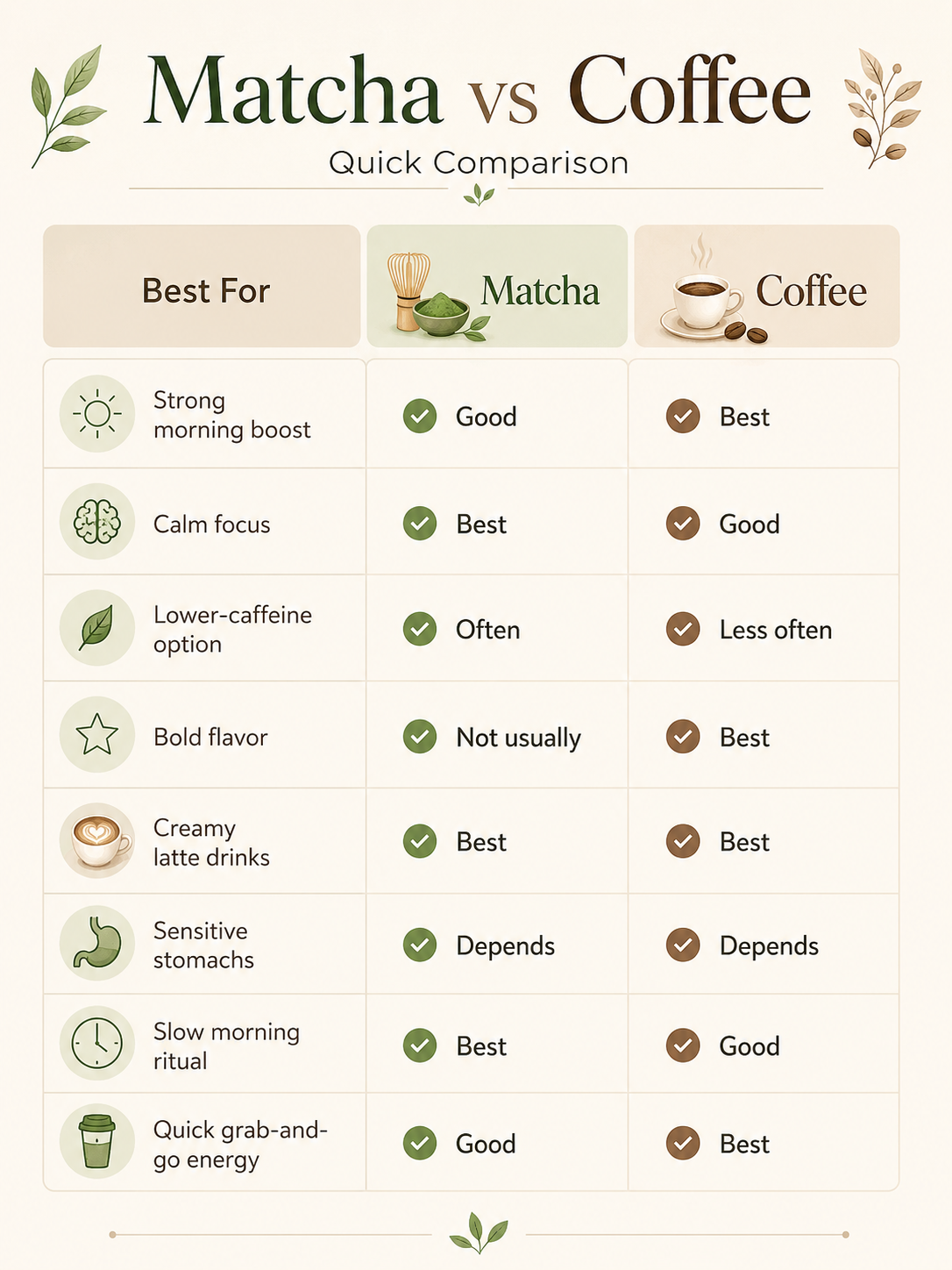
Coffee is usually the stronger, faster push. Matcha is often the gentler, steadier sip.
This guide will help you compare caffeine, energy, taste, focus, digestion, jitters, and health benefits without turning your breakfast into a science fair project. By the end, you’ll know whether your morning cup should be rich and roasty, smooth and green, or—plot twist—both, depending on the day.
Because the best drink is not the trendiest one.
It’s the one that helps you feel like yourself.
Matcha vs Coffee: Quick Answer
Choose coffee if you want a stronger, faster boost.
Choose matcha if you want a smoother, gentler kind of energy.
That is the simple answer. But morning drinks are not simple creatures. They come with moods, routines, stomach opinions, sleep consequences, and the occasional “why am I suddenly reorganizing my pantry at 7:42 a.m.?” moment.
Coffee usually has more caffeine per typical serving, which is why it can feel like a quick switch from “barely awake” to “let’s handle life.”
The FDA says up to 400 mg of caffeine per day is not generally associated with negative effects for most adults, but caffeine sensitivity varies widely from person to person.
Matcha still contains caffeine because it is a form of green tea, and green tea naturally contains caffeine. But matcha also contains L-theanine, an amino acid often associated with a calmer-feeling tea experience.
So, the better question is not, “Which one is healthier?”
It is: Which one helps you feel better today?
Here is the cozy little truth: you do not have to pledge lifelong loyalty to one cup.
You can be a coffee person on Monday, a matcha person on Tuesday, and a “please do not speak to me until I have whichever one is closest” person by Friday.
Your body gets a vote.
What Is Matcha?
Matcha is powdered green tea.
But that tiny sentence does not fully explain why matcha feels so different from the green tea bag sitting in the back of your pantry, quietly waiting for its comeback era.
With regular green tea, you steep the leaves in hot water, then remove them. With matcha, the tea leaves are finely ground into a powder. You whisk that powder into water or milk and drink the whole leaf.
That is why matcha looks so bold. It is not pale, shy, “maybe-I’m-tea” green.
It is green-green.
Like spring grass. Like a tiny wellness forest. Like your cup just got back from a yoga retreat and wants to tell you about it.
Because you are drinking the powdered leaf, matcha has a richer body than regular green tea. It can taste earthy, grassy, slightly sweet, creamy, and a little savory. That savory quality is often called umami, which is a fancy little word for “deep, satisfying flavor.”
When matcha is good and prepared well, it tastes smooth and comforting.
When matcha is poor quality or made with boiling water, it can taste bitter enough to make you question your life choices.
Why Matcha Feels Different From Regular Green Tea
Matcha feels different because it is more concentrated than steeped green tea.
Instead of sipping an infusion, you are drinking the finely ground tea leaves themselves. That gives matcha its stronger color, fuller texture, and more noticeable flavor.
It also gives matcha its personality.
Regular green tea is like a soft-spoken friend. Matcha walks in wearing linen, carrying a bamboo whisk, and somehow makes your kitchen counter look calmer.
You can enjoy matcha in several simple ways:
Hot matcha, whisked with warm water.
Iced matcha, shaken or whisked and poured over ice.
Matcha latte, blended with milk for a creamy morning drink.
Flavored matcha, with vanilla, honey, maple syrup, coconut milk, or strawberry.
For beginners, a matcha latte is often the easiest place to start. Milk softens the grassy flavor and makes the drink feel cozy instead of intense.
Think of it as matcha with a welcome mat.
For a deeper look at matcha’s story, flavor, and ritual, you can also explore our guide: The Matcha Movement: Unveiling the Green Wonder.
What Is Coffee?
Coffee is brewed from roasted coffee beans, which are actually the seeds of coffee cherries.
A tiny botanical surprise, right?
That morning mug may look simple, but coffee has a whole personality built into it: the bean, the roast, the grind, the water, the brew method, the milk, the sweetener, the “I need this before I can be kind to emails” energy.
Coffee can be bold, bitter, smoky, nutty, chocolatey, fruity, smooth, or sharp. A dark roast may taste rich and intense. A lighter roast can feel brighter and more acidic. Espresso is concentrated and strong. Cold brew is often smoother and softer. Drip coffee is the dependable classic—the jeans-and-white-shirt of the beverage world.
Coffee’s biggest appeal is its speed.
Not just how quickly you can brew it, but how quickly many people feel it. One cup can make the morning feel less like a foggy hallway and more like a room with the lights turned on.
That is why coffee has become such a loyal part of daily life for so many people. It is not just a drink. It is a signal.
The day is starting.
Why Coffee Feels So Energizing
Coffee often feels more energizing than matcha because a typical cup usually delivers a stronger caffeine hit.
That does not make coffee “better.” It makes it louder.
Coffee is the friend who claps once and says, “Okay, let’s move.” Matcha is the friend who opens the curtains slowly and hands you a clean notebook.
Both are useful. But they feel different.
Coffee may be the better choice when you need a strong push: an early meeting, a busy morning, a workout, or a day when your brain is still wearing pajamas.
But that same strong lift can feel like too much for some people. Coffee may leave sensitive drinkers feeling jittery, anxious, shaky, or suddenly convinced they should reorganize the entire spice cabinet.
Again, your body gets a vote.
If coffee makes you feel focused and happy, lovely. Keep the mug.
If coffee makes you feel like your nervous system just joined a marching band, matcha may be a gentler place to start.
Matcha vs Coffee: Caffeine Compared
This is the part where we ask the very practical question:
How awake are we trying to be here?
Coffee and matcha both contain caffeine, but they usually do not deliver it in the same way. Coffee is often stronger per typical serving. Matcha is usually more moderate, though it can still be very much awake-and-reporting-for-duty.
The exact amount depends on many tiny details: how much matcha powder you use, how strong your coffee is, how large your mug is, whether you brewed drip coffee, espresso, cold brew, or a latte, and whether your “one cup” is a dainty 8 ounces or a heroic tumbler that could hydrate a houseplant.
For most adults, the FDA cites 400 mg of caffeine per day as an amount not generally associated with negative effects, while also noting that people vary in how sensitive they are to caffeine.
That last part matters.
Because caffeine is personal.
One person drinks coffee at 3 p.m. and sleeps like a baby. Another has half a latte at noon and is staring at the ceiling at midnight, mentally redesigning the laundry room.
Which One Has More Caffeine?
Coffee usually has more caffeine than matcha in a typical morning serving.
Mayo Clinic lists an 8-ounce brewed coffee at about 96 mg of caffeine, while an 8-ounce brewed green tea is listed around 29 mg. Matcha is more concentrated than regular brewed green tea because you consume the powdered tea leaf, so its caffeine can vary depending on the amount of powder used.
In plain kitchen language: a small, lightly prepared matcha may feel gentle. A strong matcha latte with extra powder may feel much closer to coffee territory.
So don’t just ask, “Matcha or coffee?”
Ask: How strong is this cup?
Which One Feels Smoother?
Many people describe matcha as smoother than coffee.
Not weaker.
Smoother.
That difference may come partly from matcha’s natural combination of caffeine and L-theanine. Tea contains amino acids along with caffeine and other compounds, and matcha is often appreciated for a calmer kind of alertness.
Coffee, on the other hand, can feel faster and sharper. That can be wonderful when you need a strong morning push. It can be less wonderful when your hands feel shaky and your thoughts start behaving like browser tabs.
Here is the easiest way to think about it:
Coffee is a light switch. Matcha is a dimmer switch.
Coffee may turn the lights on quickly. Matcha may help you brighten the room more gradually.
Neither is automatically better. The better cup is the one that matches your morning, your body, and your plans after breakfast.
Energy and Focus: Which One Helps You Feel Better?
Energy is not just “awake” or “not awake.”
It has texture.
Some energy feels bright and useful. You answer emails, make breakfast, remember where you put your keys, and suddenly feel like a person with a plan.
Other energy feels like a tiny squirrel moved into your chest and found Wi-Fi.
That is why the Matcha vs Coffee question is not only about caffeine numbers. It is about how each drink makes you feel after the first few sips.
Coffee often gives a faster, stronger lift. For many people, it feels like momentum in a mug. You drink it, and the day starts moving.
Matcha tends to feel softer for many tea lovers. Still energizing, but less like a push and more like a steady hand on your back.
Coffee says, “Go.”
Matcha says, “Begin.”
Choose Coffee If You Need a Strong Push
Coffee may be the better choice when you want quick alertness.
Think early meetings. Long drives. Busy mornings. Workout days. Or those mornings when your brain seems to be buffering with a little spinning wheel in the middle.
Coffee’s bold flavor and stronger caffeine profile can make it feel more direct. It is familiar, fast, and easy to build into a routine.
For some people, that is exactly what works.
A cup of coffee can help you feel sharper, more awake, and ready to deal with the day’s practical little dramas: inboxes, errands, deadlines, and the mysterious disappearance of clean socks.
But coffee can also be too much.
If it leaves you shaky, tense, anxious, or hungry-but-not-hungry, your body may be telling you that the boost is stronger than you need.
That is not a character flaw.
That is feedback.
Choose Matcha If You Want Calm Productivity
Matcha may be the better choice when you want energy with a softer edge.
This is where matcha shines: writing, studying, planning, creative work, slow mornings, or long work blocks where you want focus without feeling rushed from the inside.
Many people love matcha because it feels less like a jolt and more like a rhythm. You whisk it. You pour it. You sip it. The ritual itself tells your body, “We are starting now, but we are not sprinting through the kitchen.”
That matters.
Especially if your mornings already feel noisy.
Matcha can be a lovely choice when you want to feel awake but not wired. Present but not pressured. Productive but not possessed by your calendar.
And yes, it still contains caffeine. Matcha is not sleepytime tea wearing green. But for many people, it feels gentler than coffee.
The best way to know?
Try paying attention after each drink. Not just for five minutes, but for the whole morning.
Ask yourself:
Did I feel focused?
Did I feel jittery?
Did my stomach feel okay?
Did I crash later?
Did I sleep well that night?
Your perfect morning drink may not be the one with the best marketing.
It may simply be the one that helps you move through the day without fighting your own nervous system.
Taste: Earthy Green or Bold and Roasty?
Taste matters.
A lot.
Because a “healthy” drink you secretly hate is not a wellness ritual. It is punishment in a cute mug.
And that is where Matcha vs Coffee becomes very personal.
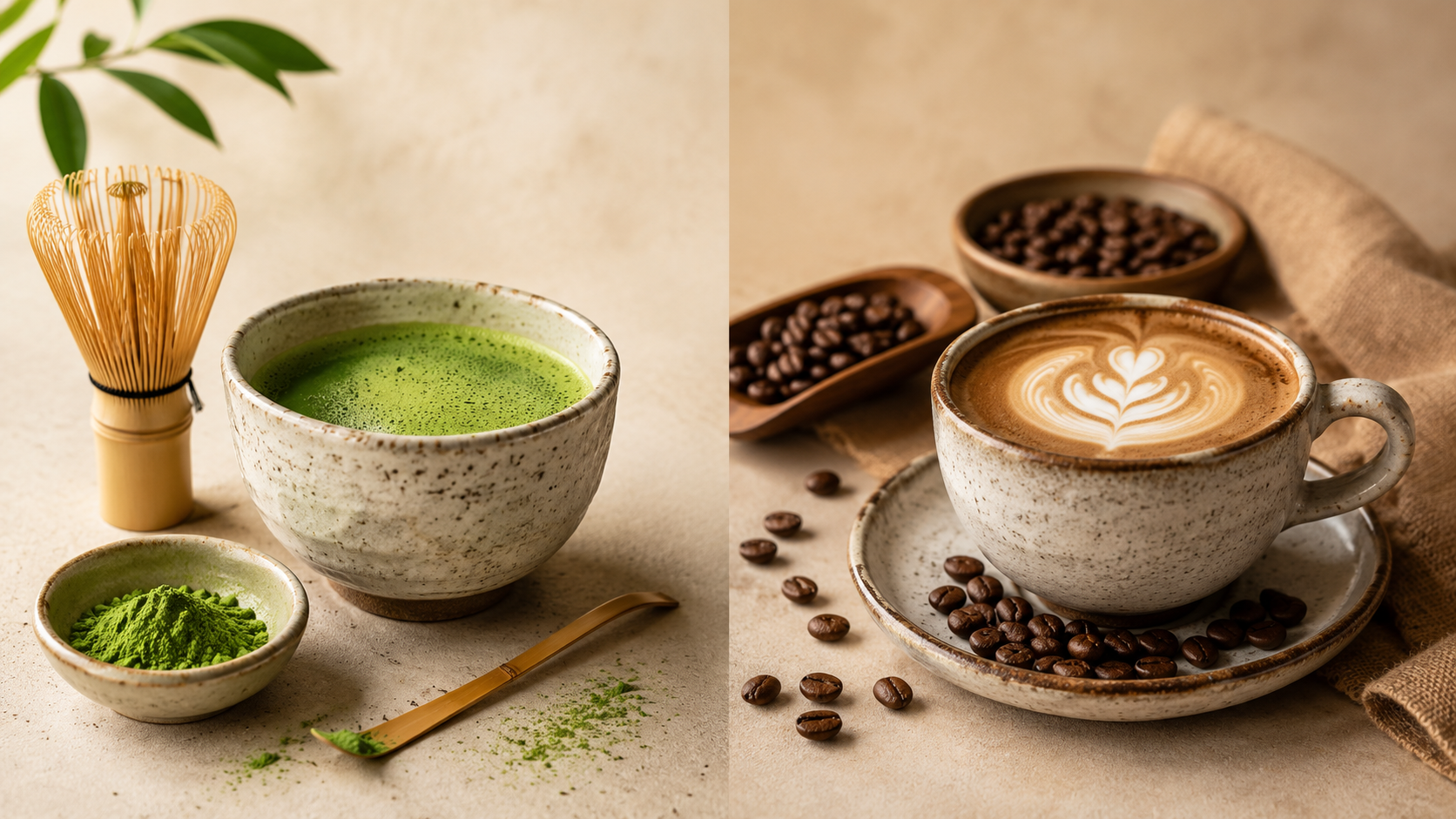
Matcha and coffee live in completely different flavor neighborhoods. Coffee is roasty, bold, deep, and familiar. Matcha is green, earthy, creamy, and a little grassy. Coffee feels like a cozy café with wooden tables. Matcha feels like soft morning light through linen curtains.
Both can be beautiful.
Both can also go terribly wrong.
Bad coffee can taste burned, sour, or bitter. Bad matcha can taste like lawn clippings with ambition.
So before you decide you “don’t like matcha” or “don’t like coffee,” look at the preparation first. Sometimes the drink is not the problem. Sometimes the water was too hot, the powder was low quality, the coffee was over-brewed, or the sweetener wandered in and took over the whole room.
Matcha Taste Tips for Beginners
If you are new to matcha, start gently.
Matcha has a naturally earthy flavor. Some people fall in love with it right away. Other people need a softer introduction, usually in the form of a latte.
A matcha latte is beginner-friendly because milk smooths the green flavor and gives the drink a creamy body. Oat milk, almond milk, coconut milk, and dairy milk can all work beautifully.
To make matcha taste better:
Use good-quality matcha powder.
Sift the powder before whisking.
Use warm water, not boiling water.
Whisk until smooth and slightly foamy.
Add milk if the flavor feels too grassy.
Try vanilla, honey, maple syrup, or cinnamon for a softer taste.
The biggest mistake is using boiling water.
Boiling water can make matcha taste bitter and harsh, like it woke up on the wrong side of the tea cabinet. Warm water keeps the flavor smoother and more balanced.
If your first matcha tastes too intense, don’t give up. Try it iced. Try it with oat milk. Try it with a tiny splash of vanilla.
Matcha sometimes needs a better introduction.
Coffee Taste Tips for Tea Lovers
Coffee can feel strong for tea drinkers.
If your usual drink is delicate green tea, chamomile, peppermint, or Earl Grey, a dark roast coffee may feel like being hugged by a bear wearing cologne.
Start softer.
A lighter roast may taste brighter and less smoky. Cold brew can feel smoother and less sharp. A latte or café au lait can make coffee creamier and gentler.
To make coffee feel more balanced:
Try a lighter or medium roast.
Add milk or oat milk for softness.
Use cinnamon for warmth.
Avoid over-brewing.
Try cold brew if hot coffee tastes too acidic.
Keep sweeteners light so the drink still tastes like coffee.
There is nothing wrong with making coffee creamy or sweet.
The only problem is when your morning coffee quietly becomes dessert with a calendar invite.
A little vanilla? Lovely.
Three pumps of syrup, whipped cream, caramel drizzle, and a cookie crumbled on top? Delicious, yes. But maybe not the everyday energy drink your nervous system requested.
So, which tastes better?
Coffee wins if you love bold, roasted, slightly bitter flavors.
Matcha wins if you love creamy, earthy, green flavors with a softer feel.
And if you love both?
Congratulations. Your morning just got options.
Health Benefits: Matcha vs Coffee
Let’s be clear before we put either drink on a tiny wellness pedestal:
Neither matcha nor coffee is magic.
No single cup can fix a sleep-deprived life, a stressful schedule, or a breakfast made entirely of vibes and leftover crackers. But both matcha and coffee can fit beautifully into a healthy routine when you enjoy them in a way that works for your body.
The real health question is not just Matcha vs Coffee.
It is also: What are you adding to it? How much are you drinking? How does it make you feel afterward? And are you sleeping like a human being or like a raccoon with responsibilities?
Potential Matcha Benefits
Matcha is made from green tea leaves, so it contains green tea compounds, caffeine, and amino acids like L-theanine. The National Center for Complementary and Integrative Health notes that green tea contains caffeine and is often promoted for mental alertness, though health claims should be viewed carefully.
Matcha may be especially appealing if you want a drink that feels energizing but still connected to a slower ritual. You sift the powder. You whisk. You watch the green swirl into the cup.
It asks you to participate.
Research on matcha is still developing, but current studies suggest possible effects on stress, attention, and memory, while also noting that more research is needed.
In everyday terms, matcha may be a good choice if you want:
A tea-based caffeine option.
A gentler-feeling morning drink.
A creamy latte without coffee.
A ritual that feels calm and intentional.
A source of green tea compounds like catechins.
That does not mean matcha is automatically healthier than coffee. It means matcha has its own strengths.
Quiet ones.
Green ones.
The kind that do not need to kick the door open.
Potential Coffee Benefits
Coffee has been studied more widely than matcha, especially because it is consumed so heavily around the world.
Harvard’s Nutrition Source notes that coffee contains caffeine, vitamin B2, magnesium, and plant chemicals, and moderate coffee intake has been linked in research with several potential health benefits.
That does not mean coffee is a prescription in a mug.
It means moderate coffee can be part of a healthy lifestyle for many people.
Coffee may be a good choice if you want:
Stronger alertness.
A bold, familiar flavor.
A drink that is easy to find almost anywhere.
A simple black coffee or lightly prepared latte.
A morning ritual you already love and tolerate well.
Coffee’s benefits can also disappear under a mountain of extras. A plain coffee and a giant dessert-style drink with whipped cream, syrup, and caramel are technically related, but so are a housecat and a lion.
Same family. Very different situation.
The Healthiest Cup Is Usually the Simplest One
For both matcha and coffee, the healthiest version is usually the one that does not turn into a sugar project.
A lightly sweetened matcha latte? Lovely.
A simple coffee with milk? Great.
A daily drink with lots of syrup, heavy cream, whipped topping, and enough sugar to make your spoon nervous? Maybe more of a treat than a morning wellness habit.
The best choice is the cup that gives you steady energy, tastes good, supports your routine, and does not leave your stomach, sleep, or nervous system filing complaints.
Matcha can be healthy.
Coffee can be healthy.
Your body decides which one gets the better review.
Digestion and Stomach Comfort
Your morning drink should help you start the day.
It should not make your stomach act like it has opened a customer service ticket.
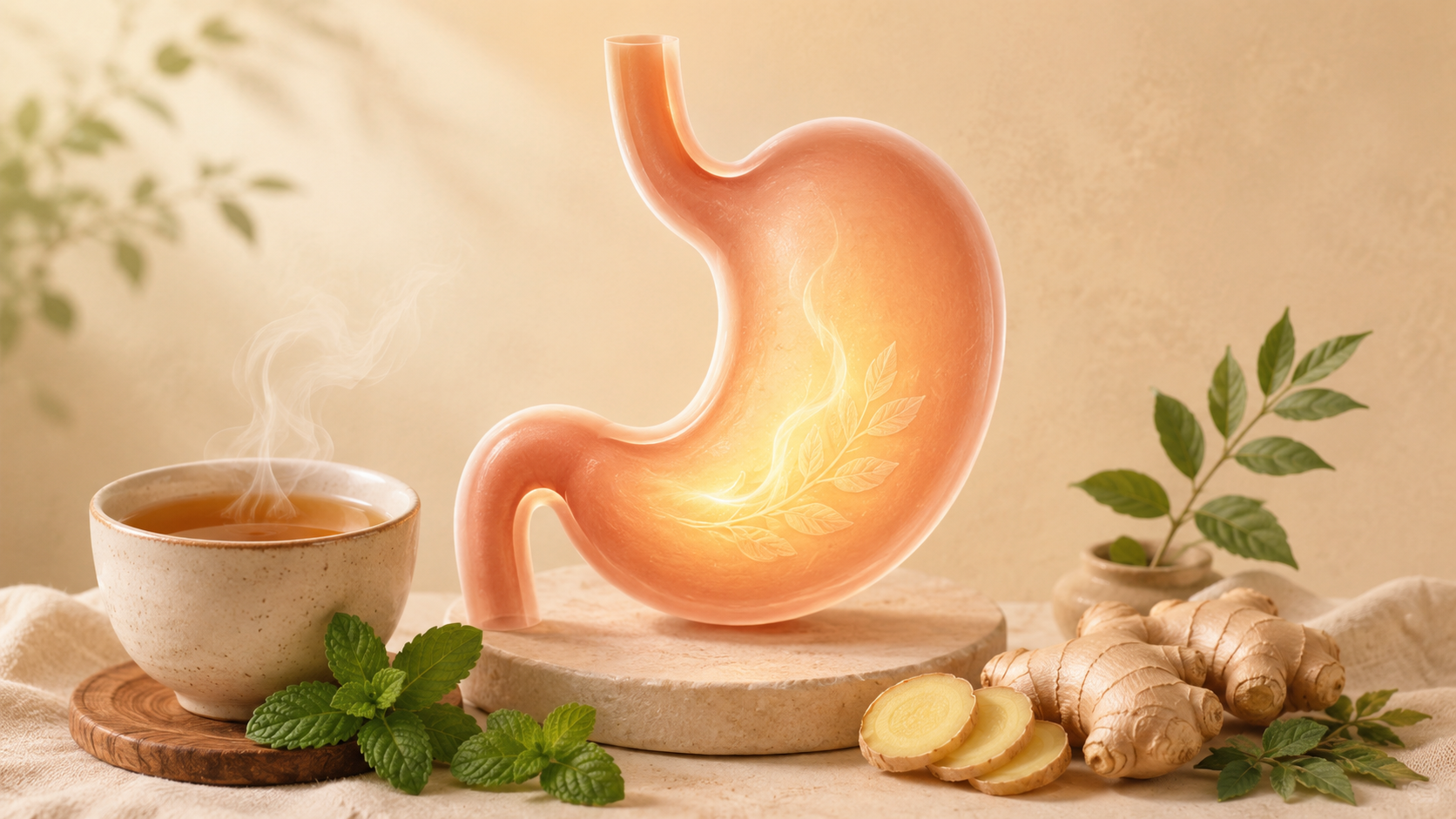
This is where Matcha vs Coffee gets a little more personal. Some people can drink black coffee on an empty stomach and feel perfectly fine. Other people take three sips and suddenly their stomach says, “Absolutely not.”
Coffee can stimulate digestion and may affect stomach acid, bile, pancreatic secretions, and colon movement. For some people, that can feel helpful. For others, especially those with sensitive stomachs, reflux, or IBS-like symptoms, it may feel too intense.
Matcha can feel gentler for some coffee-sensitive drinkers, especially as a latte. But matcha is not automatically stomach-proof. It still contains caffeine, and strong matcha on an empty stomach may bother some people, too.
In other words: your stomach gets a vote, too.
A loud one.
Try Matcha If Coffee Feels Too Harsh
Matcha may be worth trying if coffee makes your stomach feel sour, jumpy, or irritated.
Start with a small matcha latte instead of a strong straight matcha. The milk can soften the flavor and make the drink feel smoother. Pair it with breakfast, even something simple like toast, oatmeal, eggs, yogurt, or fruit.
Tiny habit. Big difference.
Also, go easy on the powder at first. More matcha does not always mean a better matcha. Sometimes it just means your cup is wearing too much perfume.
Try this beginner-friendly approach:
Use ½ to 1 teaspoon matcha powder.
Whisk with warm water, not boiling water.
Add milk of choice.
Drink it with food.
Notice how your stomach feels for the next few hours.
That last step is the most important one.
Your body is not being dramatic. It is giving you data.
Try Coffee If Matcha Feels Too Grassy or Heavy
Matcha is lovely.
But it is not for everyone.
Some people dislike the earthy taste. Some find it too grassy. Some feel a little queasy if they drink it too strong or too early. That does not mean you failed at wellness. It means you met a drink and the chemistry was not there.
Coffee may still be your better morning match.
To make coffee gentler, try a smaller serving, a medium roast, cold brew, or coffee with milk. Some people also do better when they avoid drinking it completely on an empty stomach.
And remember: digestion is not only about the drink.
The extras matter.
A plain coffee may feel fine. A giant sweet latte with syrup and heavy cream may not. A simple matcha may feel light. A very sweet matcha latte with lots of milk may feel heavy.
So when your stomach reacts, look at the whole cup—not just the headline ingredient.
For more tea-based stomach support ideas, explore our guide: Tea for Digestion: How Tea Can Soothe and Support Your Digestive Health.
Matcha vs Coffee for Anxiety, Jitters, and Sleep
Caffeine can be wonderful.
It can also be dramatic.
One minute, you are sipping your morning drink like a peaceful person. The next, your heart is tap dancing, your thoughts are speed-walking, and your nervous system has formed a committee.
That is why this part of the Matcha vs Coffee conversation matters so much.
Coffee and matcha both contain caffeine. So if you are sensitive to caffeine, neither one gets a free pass. But because coffee usually has a stronger caffeine hit per typical serving, it may be more likely to cause jitters, anxious feelings, insomnia, upset stomach, or a racing heart in sensitive people.
Matcha may feel gentler for some people because it usually contains less caffeine than coffee and includes L-theanine. But “gentler” does not mean “caffeine-free.”
Tiny but important difference.
Matcha can still keep you awake. It can still feel like too much if you drink a strong serving, drink it late in the day, or already know caffeine makes you feel jumpy.
When to Choose Matcha
Choose matcha if coffee makes you feel shaky, anxious, or overstimulated.
Matcha may be a better fit for mornings when you want focus without feeling like your brain opened 19 tabs and forgot which one was playing music.
It can also be a smart swap if you are trying to lower your caffeine intake without giving up the cozy ritual of a morning drink. Start with a simple matcha latte, use a modest amount of powder, and drink it with breakfast.
That gives your body a softer landing.
Matcha may work especially well if you want:
Calm morning focus.
A slower ritual.
Less intense caffeine.
A coffee alternative that still feels special.
A drink that pairs well with milk, vanilla, honey, or cinnamon.
But pay attention to timing. Caffeine too late in the day may interfere with sleep, even when the drink feels gentle.
So if bedtime is 10 p.m., your matcha-at-5-p.m. habit may not be as innocent as it looks.
When to Choose Coffee
Choose coffee if you tolerate caffeine well and want stronger alertness.
Coffee can be perfect for early mornings, demanding workdays, long drives, or days when you need a more obvious lift. Some people drink coffee daily and feel focused, steady, and perfectly fine.
Lovely.
But if coffee makes you irritable, tense, shaky, sweaty, nauseous, or unable to sleep, your body is not being inconvenient.
It is giving you a review.
And possibly one star.
Try a smaller serving, switch to half-caf, drink it earlier, or pair it with food. You can also rotate coffee and matcha depending on your day: coffee when you need a stronger push, matcha when you want a softer start.
The best rule is simple: listen to the after-feeling.
Not just the first sip.
The whole morning. The afternoon. The night of sleep after.
Because the best caffeinated drink is not the one that makes you feel amazing for 20 minutes and then leaves you emotionally negotiating with your pillow at midnight.
Which One Is Better for Weight Loss?
Let’s handle this gently and honestly.
Neither matcha nor coffee is a magic weight-loss drink.
I know. Very rude of them.
Both can be part of a healthy routine. Both can give you caffeine. Both can be low in calories when you drink them plain or lightly prepared. But neither one can outsmart sleep deprivation, stress, skipped meals, or a daily latte that has quietly become a milkshake with a wellness sticker.
When people ask about Matcha vs Coffee for weight loss, the real answer usually has less to do with the green powder or the roasted beans—and more to do with what goes into the cup.
A plain matcha with water is very different from a large sweet matcha latte with syrup and sweetened milk.
Black coffee is very different from a caramel-drizzled coffee drink wearing whipped cream like a winter hat.
Same category. Different story.
The Real Question: What Are You Adding?
Green tea compounds and caffeine may have a modest effect on body weight, but results vary. Caffeine is often promoted for weight loss, but caffeine alone does not create significant weight loss on its own.
So yes, unsweetened matcha or coffee may support a balanced routine.
But no, your mug is not doing the whole job.
The everyday extras matter most:
Sugar
Syrups
Sweetened creamers
Whipped cream
Large serving sizes
Sweetened plant milks
“Just a little” drizzle that somehow becomes dessert architecture
A simple matcha latte with milk and a touch of honey can be a lovely morning drink. A simple coffee with milk and cinnamon can be lovely, too.
The trouble starts when the drink stops being a drink and becomes a cupcake with a straw.
So Which One Wins?
For weight loss, the “winner” is usually the one you can enjoy simply and consistently.
Choose matcha if it helps you replace a sugary coffee drink with something calmer and less sweet.
Choose coffee if you enjoy it black or lightly prepared and it helps you feel energized for your morning routine.
Choose neither as a weight-loss shortcut.
Your best cup is the one that supports your day without sneaking in more sugar, calories, or caffeine than your body actually wants.
Small reminder, because it matters: if weight loss is tied to a medical condition, medication, pregnancy, disordered eating history, or major health changes, it is worth talking with a qualified healthcare professional.
Your body deserves better than advice from a trendy mug.
How to Choose: Matcha or Coffee?
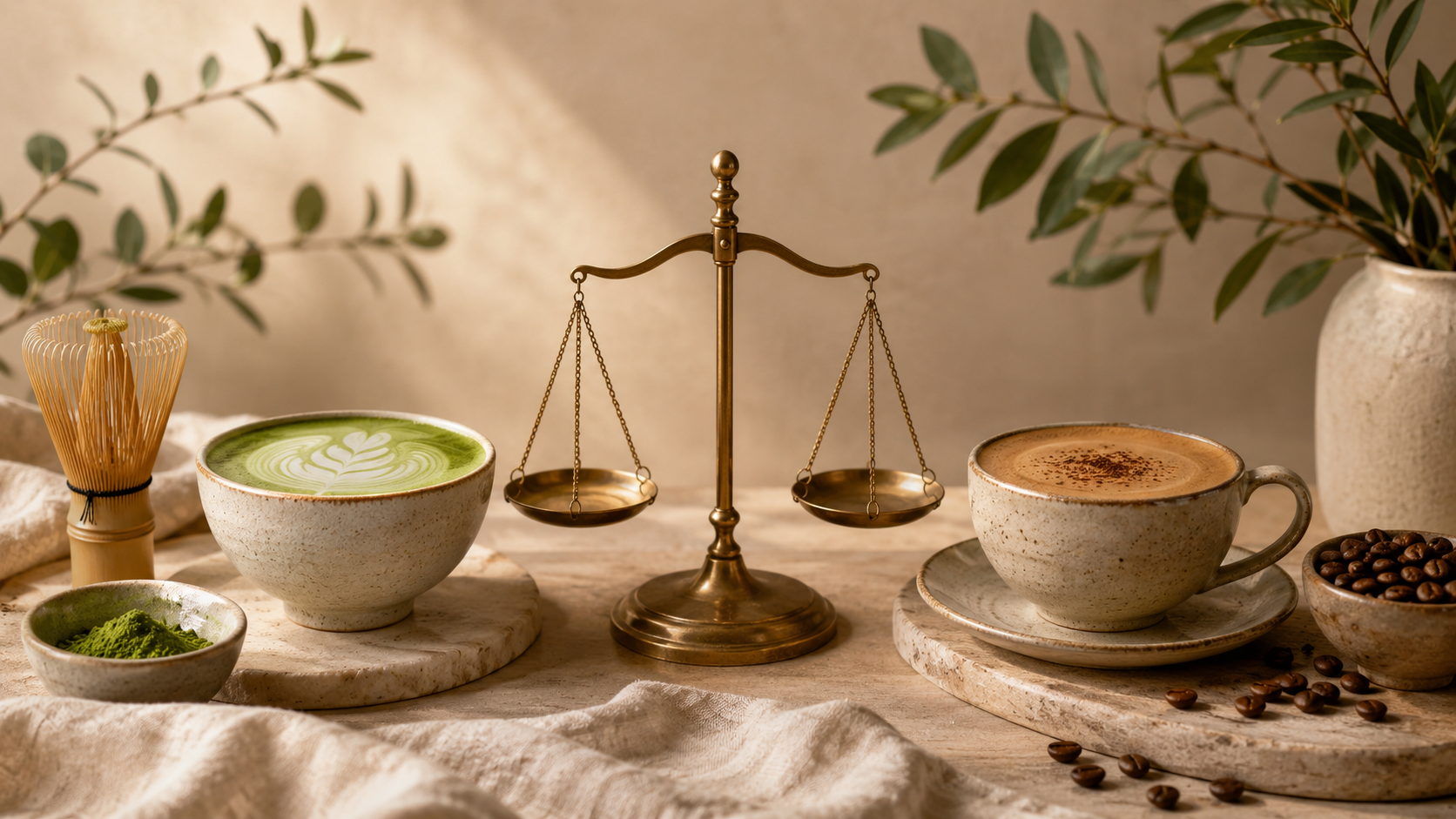
Here is the kindest way to answer the Matcha vs Coffee question:
Don’t choose the drink with the better reputation.
Choose the drink that gives you the better day.
Because your morning cup is not just a beverage. It is a tiny agreement with your body. You are saying, “Here. Let’s begin.” And your body gets to say, “Thank you,” or “Why have you done this to me?”
So instead of asking which one is universally better, ask which one fits your energy, stomach, schedule, taste, and sleep.
That answer may change.
You are allowed to be a matcha person on calm workdays and a coffee person on busy errand days. You are allowed to love coffee but switch to matcha when your nervous system needs a softer morning. You are allowed to enjoy both without turning breakfast into a personality test.
Choose Matcha If…
Choose matcha if you want a gentler caffeine experience.
Matcha may be a better fit if coffee makes you feel jittery, anxious, rushed, or too wired too quickly. It can also be a lovely choice if you enjoy slower rituals: sifting the powder, whisking it smooth, pouring it over milk, and watching that soft green swirl happen.
Tiny joy.
Very underrated.
Matcha may be your better morning drink if:
You want calm focus.
Coffee feels too harsh.
You love tea rituals.
You enjoy creamy green lattes.
You want a lower-caffeine option than coffee.
You like earthy, grassy, slightly sweet flavors.
You want a drink that feels slow and intentional.
Matcha is especially nice for writing, studying, planning, creative work, or quiet mornings when you want energy without feeling chased by your own calendar.
Choose Coffee If…
Choose coffee if you want a stronger, faster lift.
Coffee may be your better choice if you tolerate caffeine well, love bold flavor, and want your morning drink to show up with a little more volume.
Some days call for that.
A packed schedule. An early appointment. A workout. A long drive. A Monday that arrives wearing boots.
Coffee may be your better morning drink if:
You want strong alertness.
You love roasty, bold flavor.
You tolerate caffeine well.
You prefer quick preparation.
You enjoy espresso drinks.
You need a more noticeable boost.
You do not feel jittery or anxious after drinking it.
Coffee is not the villain. Matcha is not the saint.
They are just different tools.
A hammer is useful. So is a paintbrush. You would not use both for the same job unless something has gone very wrong in your kitchen.
Choose Both If…
You can also choose both.
Not necessarily in the same giant cup—although dirty matcha lattes exist, and they have their fans. But you can rotate them based on what your day needs.
Try coffee when you need a strong morning push.
Try matcha when you want steady focus.
Try coffee before a workout.
Try matcha for a slower work session.
Try coffee on days when you slept well.
Try matcha on days when your stress level is already wearing tap shoes.
You can even do a simple three-day test:
For three mornings, drink coffee and notice your energy, digestion, mood, focus, and sleep.
Then for three mornings, drink matcha and notice the same things.
No judgment. No drama. Just data from your own body.
Because the best morning drink is not the one winning online.
It is the one that helps you feel steady, awake, and like yourself.
Easy Morning Drink Ideas
Now that we have compared caffeine, focus, taste, digestion, sleep, and the whole tiny emotional weather system inside your morning cup, let’s make this practical.
Because knowing the difference between matcha and coffee is nice.
But knowing what to make tomorrow morning?
That is where the kettle meets the counter.
You do not need a complicated routine. You do not need a café-level setup. You do not need to become the kind of person who says “mouthfeel” before 8 a.m.
You just need one simple drink that helps your day start better.
Simple Iced Matcha Latte
An iced matcha latte is one of the easiest ways to start with matcha, especially if you are new to its earthy flavor.
It is creamy, fresh, and gentle enough for mornings when hot coffee feels too intense.
To make it, whisk or shake:
1 teaspoon matcha powder
2 tablespoons warm water
1 cup milk of choice
Ice
Optional: vanilla, honey, maple syrup, or a little cinnamon
The trick is to mix the matcha with warm water first. This helps prevent clumps, which are the tiny green goblins of the matcha world.
Then pour it over ice and milk.
Smooth. Simple. Pretty enough to make your kitchen feel like it has better lighting.
Cozy Hot Matcha Latte
A hot matcha latte is for slower mornings.
The kind where you want to hold the mug with both hands and pretend, even briefly, that your inbox does not exist.
To make it, whisk:
1 teaspoon matcha powder
2 tablespoons warm water
¾ to 1 cup warm milk
Optional: honey, vanilla, maple syrup, or cinnamon
Use warm water, not boiling water. Boiling water can make matcha taste bitter, and bitter matcha has a very specific “why did I do this?” energy.
A warm matcha latte is especially nice if you want calm focus before writing, planning, studying, or doing quiet work.
It feels less like a caffeine alarm and more like a soft start.
Simple Better Coffee Routine
Coffee does not need to be complicated, either.
A better coffee routine can be as simple as making your usual cup slightly gentler, less sugary, or more intentional.
Try:
Brewed coffee or espresso
Milk or oat milk
Cinnamon
A small splash of vanilla
Optional: a little honey or maple syrup
If coffee sometimes feels too sharp, try cold brew, a lighter roast, or a smaller serving. You can also drink it with breakfast instead of on an empty stomach.
Tiny changes can make your coffee feel less like a fire alarm and more like a friendly nudge.
And if you already love coffee exactly as it is?
Beautiful. Keep your joy.
A Simple Weekly Rotation
You can also build a tiny rhythm around both drinks.
Try this:
Monday: Coffee for a strong start.
Tuesday: Matcha for calm focus.
Wednesday: Coffee before a busy morning.
Thursday: Matcha latte for a gentler routine.
Friday: Your favorite cup, no overthinking.
This keeps your routine flexible. It also helps you notice patterns.
Maybe coffee works best when you slept well. Maybe matcha works better when you feel stressed. Maybe iced matcha is your afternoon sweet spot, while coffee belongs firmly in the morning.
That is the goal.
Not rules.
Awareness.
Your perfect morning drink is allowed to change with your season, schedule, sleep, hormones, stress, and taste buds. You are not a machine. You are a person with a mug.
And the mug should help.
Final Verdict: Matcha vs Coffee
So, after all this sipping and comparing and caffeine soul-searching, where do we land?
Here:
Coffee is best when you want stronger, faster energy.Matcha is best when you want smoother, calmer focus.
That is the whole little truth.
No villain. No saint. No beverage wearing a crown.
Coffee can be a beautiful choice if your body handles caffeine well and you love that bold, roasty flavor. It is practical, familiar, and wonderfully direct. Coffee does not tiptoe into the morning. It arrives with shoes on.
Matcha can be a beautiful choice if coffee feels too intense, or if you want a slower ritual with a gentler kind of lift. It is creamy, green, earthy, and calm in a way that makes the morning feel less like a race and more like a beginning.
The real winner in Matcha vs Coffee is not the drink with the trendiest reputation.
It is the one that helps you feel good after the cup is empty.
Not just during the first delicious sip.
After.
Ask yourself:
Did I feel focused or scattered?
Did I feel energized or jittery?
Did my stomach feel calm or annoyed?
Did I crash later?
Did I sleep well that night?
Did I actually enjoy drinking it?
That last one matters more than wellness culture sometimes admits.
You do not need to force yourself to drink matcha if you hate it. You do not need to quit coffee if it works beautifully for you. And you do not need to choose one forever, as if your mug requires a legally binding commitment.
Try this instead:
Drink coffee for three mornings. Notice how you feel.
Then drink matcha for three mornings. Notice again.
No drama. No judgment. Just you, your body, and a small morning experiment.
Because the best morning drink is not the one winning on TikTok, sitting prettily on Pinterest, or being praised by someone with impossibly organized kitchen shelves.
The best morning drink is the one that helps you feel like yourself before 10 a.m.
FAQ: Matcha vs Coffee
Is matcha healthier than coffee?
Not automatically.
Matcha and coffee can both be healthy choices when you enjoy them in a simple, balanced way. Matcha gives you a tea-based caffeine option with green tea compounds and L-theanine. Coffee gives you a stronger caffeine boost and has been widely studied for its role in a healthy routine.
But the healthiest cup usually comes down to your body and your habits.
A simple matcha latte with light sweetness? Lovely.
A black coffee or coffee with a splash of milk? Also lovely.
A giant syrup-heavy drink wearing whipped cream like a party hat? Delicious, yes. But probably more of a treat than an everyday wellness drink.
Does matcha have less caffeine than coffee?
Usually, yes.
A typical cup of coffee often has more caffeine than a typical serving of matcha. That is why coffee usually feels stronger and faster.
But matcha is not caffeine-free. The amount depends on how much matcha powder you use. A light matcha latte may feel gentle. A strong matcha with extra powder may feel much closer to coffee.
So when comparing Matcha vs Coffee, don’t only ask which drink has caffeine.
Ask how much is in your cup.
Is matcha better than coffee for anxiety?
For some people, yes.
Matcha may feel gentler because it usually has less caffeine than coffee and contains L-theanine. Many people describe matcha energy as calmer, smoother, and less jittery.
But matcha still contains caffeine. So if caffeine tends to make you anxious, shaky, or restless, matcha can still affect you.
Your best test is simple: try matcha in the morning with food, use a modest amount of powder, and notice how your body feels over the next few hours.
Your nervous system will give you the review.
Can I drink matcha and coffee in the same day?
Yes, if your body handles caffeine well.
You might enjoy coffee in the morning when you want a stronger boost, then matcha earlier in the afternoon when you want a softer lift. But keep an eye on your total caffeine intake and your sleep.
If you feel jittery, anxious, wired, or wide awake at bedtime, your body may be asking for less caffeine or an earlier cut-off time.
Caffeine is not just about the cup.
It is about the timing, too.
Which is better before a workout?
Coffee may be better if you want a stronger, faster push.
Matcha may be better if you want a gentler kind of energy that feels less intense.
It depends on how your body responds. Some people love coffee before exercise. Others feel shaky or uncomfortable. Some prefer matcha because it feels lighter and smoother.
Try each one before a low-pressure workout first. Do not test a brand-new caffeine routine before a big run, intense class, or anything where your stomach might decide to become the main character.
Which is better for studying or work focus?
Matcha may be better for calm focus.
Coffee may be better for strong alertness.
If you are writing, studying, planning, or doing creative work, matcha can feel like a steady companion. If you are tired and need to wake up quickly, coffee may be more effective.
Think of it this way:
Coffee helps you start fast.
Matcha helps you settle in.
Both can help. The better choice depends on whether your brain needs a jump-start or a gentle lane to drive in.
Can matcha replace coffee?
Yes, matcha can replace coffee if you enjoy the taste and feel good after drinking it.
Start slowly. Swap one coffee for one matcha latte a few mornings a week. Notice your energy, mood, digestion, cravings, and sleep.
You do not have to quit coffee dramatically, like a beverage breakup scene in a movie.
You can simply rotate.
Coffee some days. Matcha other days. Peace in the mug.
Is matcha good for beginners?
Yes, especially as a latte.
If straight matcha tastes too grassy, start with an iced matcha latte or hot matcha latte. Milk softens the flavor and makes the drink creamier. Vanilla, honey, maple syrup, or cinnamon can also help.
Use warm water, not boiling water.
Sift the powder.
Whisk well.
Tiny steps. Much smoother cup.
Build a Morning Ritual That Actually Fits Your Life

Your best morning drink does not need to impress anyone.
It just needs to help you feel steady, awake, and a little more ready for the day in front of you.
So tomorrow morning, try one small experiment: make your usual cup, then notice how you feel after it. Not just during the first sip. After breakfast. Mid-morning. Late afternoon. Bedtime.
Then try the other drink another day.
Coffee may be your bold little morning engine. Matcha may be your calmer green companion. Or maybe both belong in your kitchen, each with its own tiny job.
That is the beauty of a good ritual.
It is not rigid.
It listens.
Advertisement